
Every so often a new competitor pops up in the pigeon software niche, and with it comes the siren song of the “lifetime deal.” Pay once, use forever. We’ve seen it before and I’m here to shine a bright light on this again. What could go wrong?
A lot, actually. And we don’t have to guess, the track record is right there.
The Setup
A new pigeon loft management tool recently launched with two options: $50/year or $500 lifetime. Ten years to break even, gravy after that. If you’ve been keeping the same lofts running since the days of rotary phones, it feels like a no-brainer.
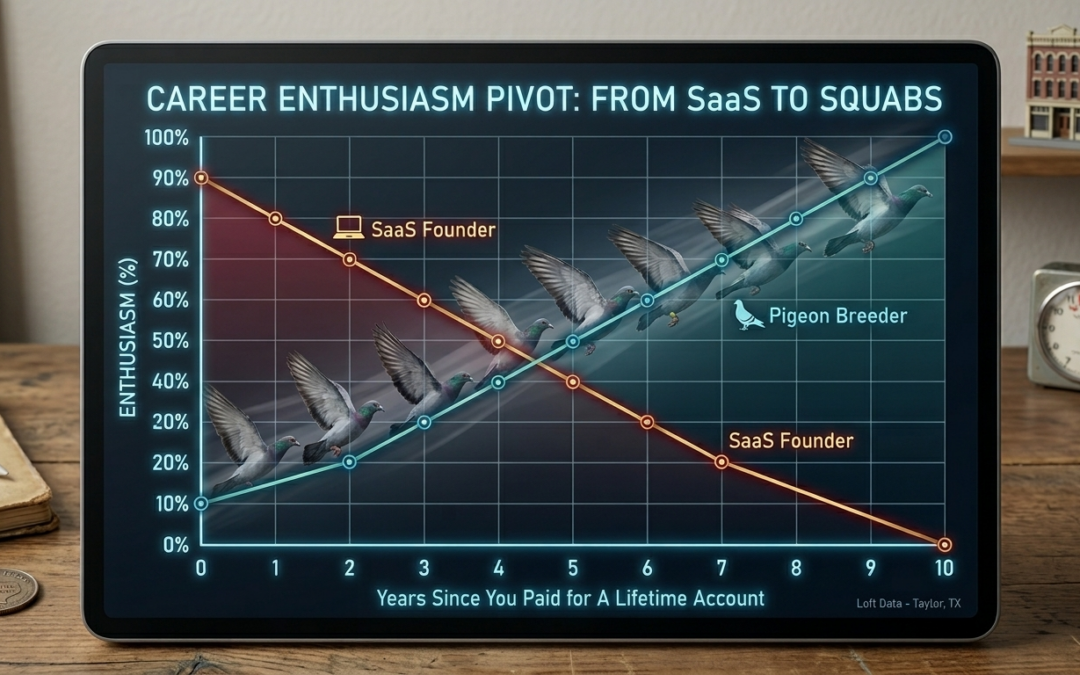
But the word “lifetime” is doing a lot of heavy lifting here. Whose lifetime? Yours? The software’s? The founder’s enthusiasm? Usually it’s the last one. Founder enthusiasm, much like a pigeon released 400 miles from home, does not always make it the whole way.
Why This Keeps Happening
This isn’t hypothetical. AppSumo — the marketplace that promotes, sells, and advertises “lifetime” SaaS deals — just publicly admitted (see post here) its revenue dropped 50% over the past two years as the entire model faces what their own CEO called an “existential crisis.”
Why? Software companies that offer lifetime plans on Saas products (Software As A Service – basically paid subscriptions) get a cash infusion upfront but take on indefinite support obligations with no recurring revenue to fund development, servers, or support. Eventually the math catches up and the money runs out. Companies either abandon their lifetime customers after cashing the check, or shut down entirely when costs exceed what they collected.
One Trustpilot reviewer put it plainly: they bought a $1,000 lifetime deal for an app called Sessions, and one day it simply stopped working and disappeared. Their compensation? A $10 coupon.
There’s a whole site, saasyrank.com, dedicated to tracking failed lifetime deals. It’s not a short list.
The Lifetime Model Quietly Falls Apart
SaaS isn’t a toaster. You’re not buying a thing — you’re buying an ongoing relationship with servers, databases, backups, bug fixes, and support emails answered at 11pm. All of that costs money every single month, forever.
When someone pays $500 once, that has to cover hosting (which goes up as data grows), ongoing development, support, security patches, and the founder’s rent. A healthy SaaS needs predictable recurring revenue (ARR) to keep existing. The moment lifetime customers become a meaningful chunk of the user base, every new one costs more to serve over time than they paid upfront.
There’s a reason Netflix and Adobe don’t offer lifetime plans. The model simply doesn’t work for products that need to keep running.
Why ARR Is A Feature, Not A Bug
Here’s the part nobody puts on a pricing page: the recurring revenue model is what pays for the product getting better.
Annual Recurring Revenue isn’t just a metric founders like to tweet about. It’s the budget that funds next year’s work. When a platform has a predictable income stream, the founder can plan roadmaps, absorb the cost of experimenting on new features, invest in infrastructure before it breaks, and say yes to the feature request that came in last Tuesday. ARR is what turns “we should build that someday” into “that ships next month.”
Lifetime deals do the opposite. The money is already spent — on last year’s servers, last year’s bugs, last year’s support tickets. There’s nothing left to fund innovation, which is why lifetime-funded products so often feel frozen in time. They launch with a flashy feature set and then quietly stop evolving, because there’s no budget to evolve with. When was the last time someone modified Loft Manager Online with meaning updates?
AI-powered pedigree scanning is a good example. Building that took real time, real API costs, real iteration. None of it would have been possible on a one-time payment made years ago. It exists because enough people renew each year to justify building it — and the next feature after that will exist for the same reason.
Annual pricing also flips the incentive in a healthier direction. The founder has to keep you happy every year. Renewal is the scoreboard. That’s the pressure that keeps someone shipping useful things to existing users instead of chasing the next lifetime cohort to plug the revenue hole.
The Alternative
PigeonDB charges $29.99/year for a premium account.
That’s not a promo. That’s the price. It’s less than the competitor’s annual plan, and over ten years you’d pay about $300 — $200 less than that lifetime deal, funding a product that actually has a reason to still exist in year ten.
What $29.99/year gets you:
- A platform ranked #1 among racing pigeon software
- AI-powered pedigree scanning that’s already in active use
- New features shipping regularly, not promised “someday”
- Real support from someone who answers emails
- The confidence that the product will still be here next season
If PigeonDB ever stops being worth $29.99, you stop paying. No sunk cost, no “well I paid $500 so I guess I’m stuck.” The pricing keeps everyone honest.
The Pigeon in the Room
Lifetime deals tap into something very human; the desire to be done with a decision, to outsmart the system. We get it. But software isn’t a system you outsmart. It’s a living thing that needs feeding. A $500 lifetime plan isn’t a bargain; it’s a bet that the founder will keep working for free, forever, to honor a deal you paid for once.
$29.99/year isn’t flashy. It just promises that next year, when you log in to check on your breeding pairs, the lights will still be on. Which, honestly, is the only kind of “lifetime” that matters.